Newer drive types
That's late enough that you're not dealing with the old chain-drive units from the 80s; you're dealing with belt and screw drives with circuit boards, safety-eye sensors, and sometimes a keypad wired into the wall.
Lucas, Anna
Opener repair for Lucas, TX homes built mostly after 2002. We travel 17 miles from Anna to fix dead openers, bad sensors, and worn gears on newer drive systems.
DIY or pro
Lucas is a small place - about 2,724 households, nowhere near the size of some of the towns we drive to - and that matters for openers because most of the housing stock here went up around 2002.
That's late enough that you're not dealing with the old chain-drive units from the 80s; you're dealing with belt and screw drives with circuit boards, safety-eye sensors, and sometimes a keypad wired into the wall.
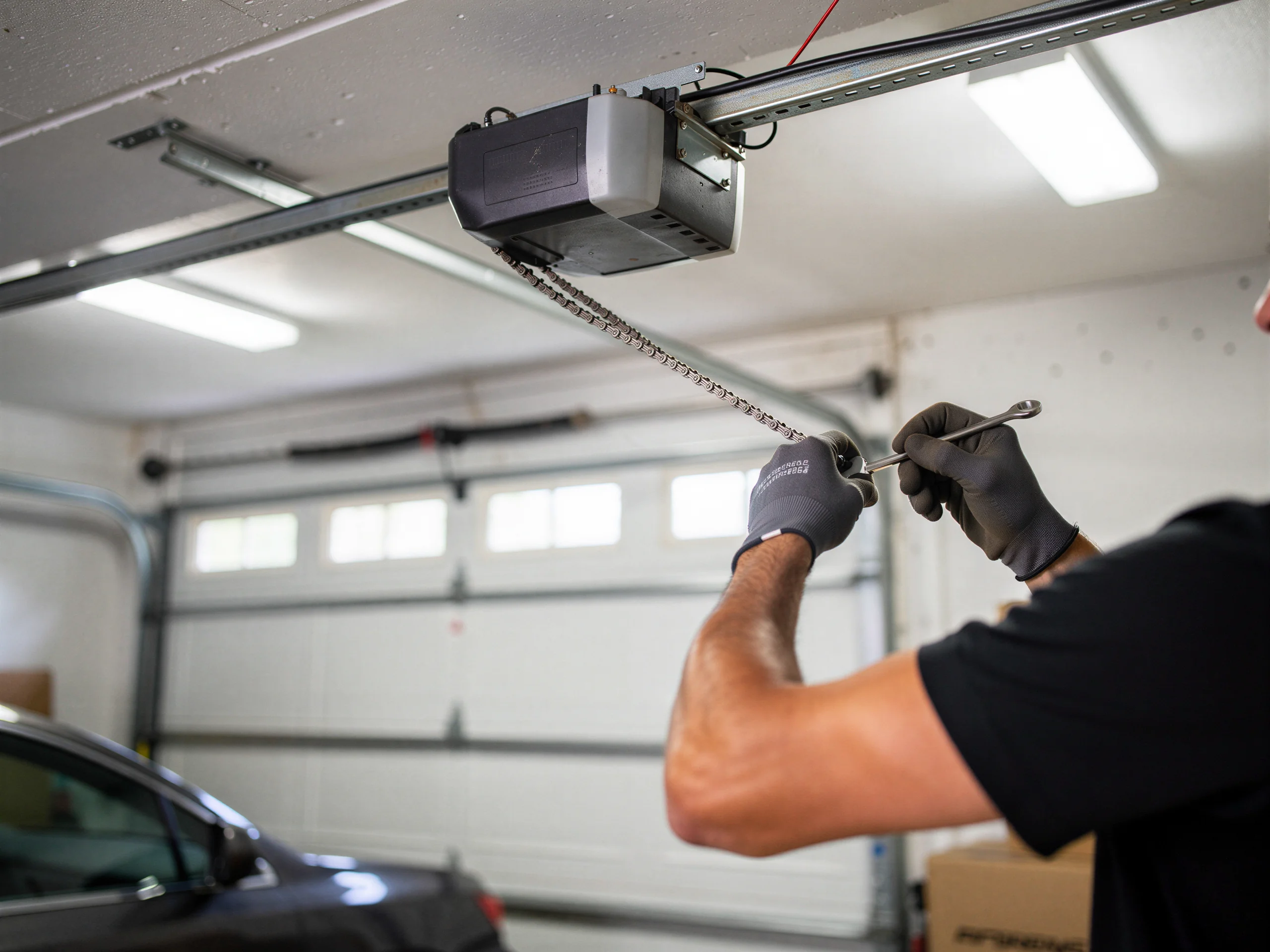
Swapping a remote battery or re-aiming a sensor eye you can do yourself, no tools needed beyond a screwdriver. Once you're into logic board faults, burnt-out capacitors, or a motor that hums but won't turn the sprocket, you're past the point where guessing saves you money.
Opening the housing on a board you don't recognize risks shorting something that was fine a minute ago. If the opener is under ten years old and otherwise sound, it's almost always one part, not the whole unit - which is the case for a lot of these newer-build Lucas houses.
The repair
We start with the logic board and the sensors before we touch the motor, because on a house built in the early 2000s the opener itself is usually younger than the door hardware around it.
We check the safety-eye alignment, test the wall control, pull the cover on the motor head to look at the drive gear, and check capacitor health on the board.
If the opener trips the breaker or won't respond to either remote or wall button, we trace it back to the board or the wiring before assuming the whole unit needs replacing.
On belt-drive units common in this era of construction, a stretched or slipping belt reads like a dead motor to most homeowners but is a different, cheaper fix. We don't guess at parts off a phone description - we look at it running, then tell you what's actually worn.
Local causes
Houses in Lucas built around 2002 are old enough now that the original opener - if it's still the one from construction - is past the point most manufacturers expect it to last. Boards degrade, capacitors dry out, and drive gears made of nylon wear thin after fifteen-plus years of daily cycles, especially in a cold-moderate climate where temperature swings stress plastic components twice a year instead of once. A lot of these homes also got midrange builder-grade openers at construction, not the heavier-duty units homeowners choose when they upgrade later. That combination - older-than-it-feels hardware plus climate cycling - is why we see more board failures and gear-strip calls in this part of the county than you'd expect from a town with $178,403 median household income and newer housing stock overall.
Pricing
We don't have a flat number to quote here - opener repair costs depend on whether it's a sensor, a board, a gear, or a motor, and we won't tell you a price before we've looked at the unit running.
What we can say: a worn drive gear or a bad capacitor is a fraction of what a full opener replacement runs, and most of what we see on 2002-era Lucas builds falls into that cheaper category rather than needing a new unit.
If the motor itself has burned out, replacement sometimes makes more sense than repair - we'll tell you straight if that's the case instead of patching something that'll fail again in six months.
Symptoms
The most common call we get out of Lucas is an opener that runs the motor but the door doesn't move, or moves partway and reverses. On houses this age, that's usually the drive gear stripped inside the motor head - a plastic part that wears down over years of cycling and finally skips instead of catching. Second most common: the opener does nothing at all when you hit the wall button or remote, which on a 2002-build points to the board or a blown fuse inside the unit rather than the door hardware itself. Less often, the light blinks and the door won't close - that's a sensor alignment issue, and it's the one thing on this list you can usually fix yourself in five minutes.
On the truck
Serving Anna, TX
We carry drive gears, logic boards, and capacitors that fit the belt and screw-drive openers common in homes built in this stretch of years, plus replacement safety sensors and wall controls. What we don't keep on the truck is a full new opener unit - if yours needs full replacement, that's a special order and we'll tell you the lead time up front rather than promise same-day on something we don't stock. We travel the 17 miles from Anna for these calls, so we try to diagnose on first visit and bring back only what's confirmed needed rather than guessing and hauling extra parts out twice.
Questions
Openers wear out on cycle count and age, not house age. A unit installed at construction in 2002 is now well past the point most manufacturers rate it for, especially the builder-grade motors common in new developments at that time. Gears and boards degrade regardless of how new the house around them is.
No. We carry the repair parts that fix most failures - gears, boards, capacitors, sensors - but a full opener unit is a special order. If yours needs full replacement, we'll tell you that on the visit and give you a lead time instead of promising something we can't deliver same day.
About 17 miles. We cover Lucas as part of our service area out of Anna, along with a number of other towns in the county. There's no local branch in Lucas itself - we drive out for the job.
It's doable if you're comfortable opening the motor housing and matching the gear exactly, but the part has to fit your specific opener model. Get it wrong and you'll strip the new one just as fast. Most homeowners find it's a short job for someone who does it regularly.
Explore more
Ready when you are
Anna Garage Door Pros repairs and installs garage doors, springs and openers in Anna, TX and the surrounding area.